The Energia Commercial Microgeneration Scheme
What is the Microgeneration Scheme?
Microgeneration refers to the generation of electricity from renewable technology such as solar PV panels. This type of renewable energy generation allows domestic customers to produce their own electricity. Homeowners who want to maximise the energy they generate can pair their panels with solar battery storage, allowing them to store surplus electricity for use later in the day.
Energia will help customers on their green journey to reduce their carbon footprint with the Microgeneration Scheme and the Clean Export Guarantee (CEG) payment.
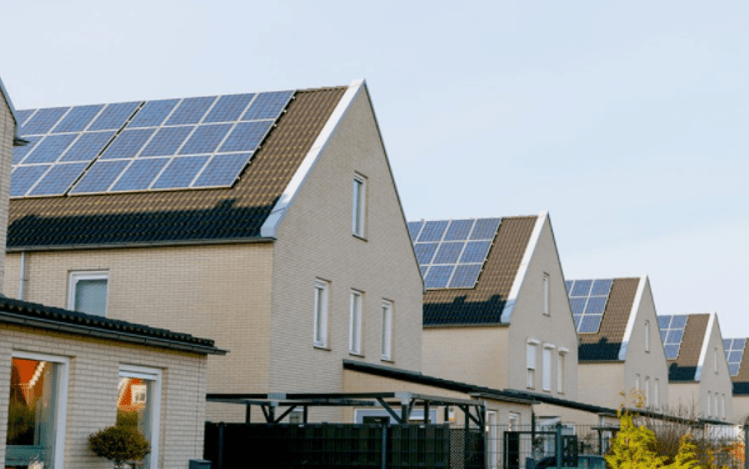
By generating electricity through microgeneration, customers may be able to generate much of their home’s electricity needs themselves. The Microgeneration Scheme was introduced for microgenerators and as part of this the Clean Export Guarantee (CEG) payment was also introduced.
For microgeneration customers this will mean that any surplus electricity produced, customers will have the option to export this to the grid and receive payment for it. Not only will microgeneration customers be contributing to a greener Ireland by exporting surplus green energy, but they will also be reducing their own electricity expenses.

Learn more about Microgeneration
Energia & the Microgeneration Scheme FAQs
Here to help.
Microgeneration means producing your own renewable electricity, usually with solar panels (Solar PV). Energia’s Microgeneration Scheme lets you earn money by sending any unused electricity back to the grid.
Key points:
- You generate clean energy at home.
- Any extra electricity you don’t use can be exported to the grid.
- Energia pays you for the electricity you export under the scheme.
Yes, if you meet the following requirements:
Eligibility checklist:
- You own a microgenerator, such as a solar PV system.
- You have an export grid connection.
- You have completed and submitted an NC6 form to ESB Networks (your installer may have done this for you at the time of installation of the microgenerator.).
What happens next:
- Once ESB Networks processes your NC6 form, they will notify Energia.
- We set up your export account and add payments to your electricity bill based on your export data.
Important for payment:
- If you don’t have a smart meter, you’ll need one installed by ESB Networks to get paid for your exported electricity.
- You can request a smart meter on the ESB Networks website.
You’ll need a smart meter to join the Microgeneration Scheme and receive payments for exported electricity.
What to do
- Request a smart meter installation from ESB Networks.
- You can make the request directly on the ESB Networks website.
Here’s how the process works and what you can do:
How it works
- ESB Networks sends Energia a notification when your microgeneration installation is registered.
- We update your account and email you to confirm we’ve received this information.
- If you haven’t heard from us
- Make sure your NC6 form and details were submitted correctly to ESB Networks.
- If everything is complete and you still haven’t received confirmation, please contact Energia for assistance.
No, not at the moment. To join the Microgeneration Scheme, your electricity import and export must be with the same supplier.
What to do if you want to join
- Sign up with Energia to avail of the scheme.
- Once you’re an Energia customer, we’ll help you set up your export account.
You’ll be paid 18.5 cent per kWh for exported electricity, credited to your Energia bill.
Payments are issued as a credit on your bi-monthly electricity bill, not as direct bank transfers.
No, your export payments will appear as credits on your existing Energia electricity account.
Your bill will show the export volume based on smart meter readings collected by ESB Networks.
You may qualify for a tax exemption of up to €400 per year on income from exported electricity. Speak with Revenue or your tax advisor for full details.
Deemed export is an estimated amount of electricity you export when you don’t have a smart meter. This method is less common now because smart meters provide accurate readings.
Good to know
- Deemed export is only used if a smart meter isn’t installed.
- Smart meters give exact export data, so they’re the preferred option.
The difference is in how your exported electricity is measured.
Key differences
- Metered export uses real-time data from your smart meter, so it’s accurate.
- Deemed export is an estimated amount used when smart meter data isn’t available.
Your earnings depend on how much excess electricity you export to the grid. With Energia’s current rate of 18.5c per kWh, exporting 1,000 kWh in a year could earn you about €185 in credits.
Good to know
- The more electricity you export, the more you earn.
- Payments are added as credits to your electricity bill.
- Check the latest Energia rates for up-to-date information.
A feed-in tariff is the payment you receive for surplus electricity exported to the grid. Energia currently pays eligible customers 18.5c/kWh via the Clean Export Guarantee.