
Successful Guinness Men’s Six Nations has Ireland well set for a huge 18 months ahead
But for a nerveless last-gasp penalty from France’s metronomic full-back Thomas Ramos, Ireland would have been crowned champions, which is a far cry from the doom and gloom that was being after they lost in Paris.
Ireland’s turnaround was remarkable, as head coach Andy Farrell set about rebuilding and rejuvenating a team that was short of several key players through injury, yet still managed to win all four games after they fell short to the eventual winners France, who just about managed to defend their title.
For all that there will naturally be some disappointment at not getting their hands on the trophy again, it’s hard to argue against the sense that France were deserving champions, especially given how much they out-played Ireland in front of their home crowd in round one.
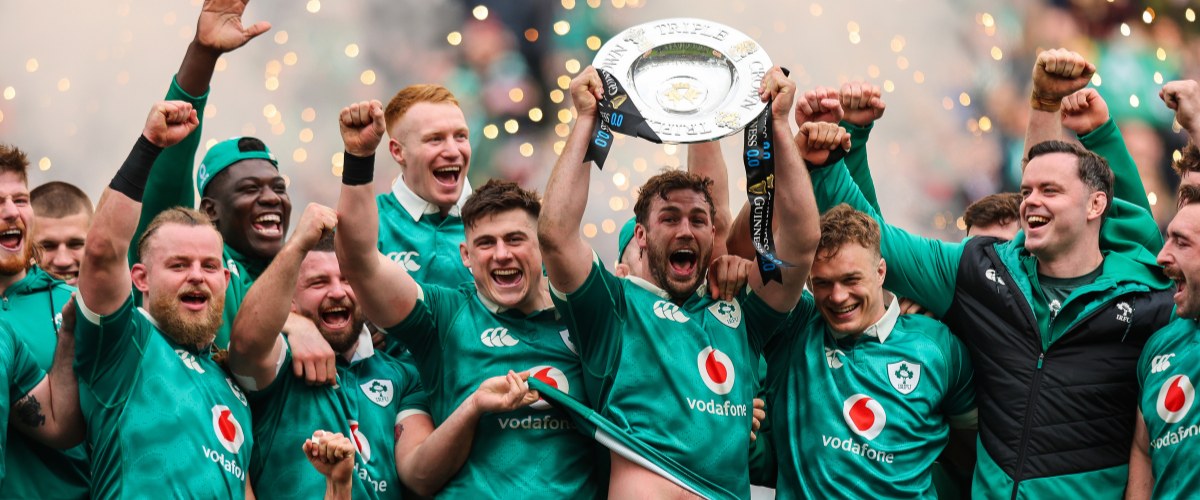
However, Ireland did at least get to savour the moment of retaining the Triple Crown in front of a packed Aviva Stadium, who were treated to a 12th consecutive victory over a Scotland side, who must be sick of the sight of Farrell’s men.
Finishing with a fourth win on the bounce, and a significant piece of silverware was a fitting reward for a successful championship that could very easily have veered even further off track. That it didn’t is testament to Farrell, his assistant coaches, and the 35 players who featured throughout.
That number is the highest Farrell has ever used in his time as Ireland boss, which is quite the feat when you consider that loosehead props Andrew Porter, Paddy McCarthy and Jack Boyle were missing through injury, as was back-row Ryan Baird, and back-three players Hugo Keenan and Mack Hansen. James Lowe also picked up an injury and missed most of the tournament.
Those setbacks meant Farrell had to dig deeper into his depth chart, as Munster second-row Edwin Edogbo made his Ireland debut off the bench in the win over Italy, while Ulster scrum-half Nathan Doak did the same against Wales.
Edogbo and Doak were two of 11 Six Nations debutants, as Tommy O’Brien, Cian Prendergast, Nick Timoney, Michael Milne, Robert Baloucoune, Cormac Izuchukwu, Tom Stewart, Tom Farrell and Darragh Murray also played in rugby’s greatest championship for the first time.
Blooding so many fresh faces bodes well for Ireland ahead of a huge 18 months on the road to the 2027 World Cup in Australia.
They will get a taste of what’s to come next year when they travel Down Under this summer to play the Wallabies and Japan in Australia before Ireland fly to Auckland to take on New Zealand at their fortress Eden Park.
You can be sure Farrell will be making it his mission to break the All Blacks' long 52-game unbeaten run at their spiritual home.
Ireland will carry with them the lessons from the Six Nations, and none more so than the regrets at starting so slowly in Paris. Farrell questioned his players’ ‘lack of intent’ following their comprehensive 36-14 defeat, but he got the desired response over the following few weeks.
Although it wasn’t initially as emphatic as Farrell would have hoped for, Ireland got back to winning ways by beating a vastly-improved Italy team 20-13 at home.
That set them up for a crack at England at Twickenham, where they produced a stunning record victory. The sound of ‘The Fields of Athenry’ ringing around London will forever linger in the memory, as Ireland destroyed England in what was a major statement of intent.
With Baloucoune and O’Brien linking brilliantly, the speedy wingers added a completely fresh dynamic to Ireland in the wide channels, and England were unable to contain them. Meanwhile, scrum-half Jamison Gibson-Park delivered one of the great individual Irish performances in recent memory.
A 42-21 five-try win breathed life back into Ireland’s title hopes, and at the same time sent out a firm message that rumours of their demise were greatly exaggerated.
Wales were next up following the break week, and while Steve Tandy’s side were gutsy in defence, Ireland got the bonus point win (27-17) they required to pile the pressure back on France, who duly slipped up the following day at Murrayfield.
That put them on course for a Triple Crown decider against Scotland, with the winners also set to jump into top spot before France hosted a beleaguered England later on the final night.
The Scots arrived in Dublin full of confidence thanks to their record victory over France, but it soon became apparent that was their 'cup final', as Gregor Townsend’s side were unable to back up the emotional and physical high, whereas Ireland were primed and ready.
With Jack Crowley again confidently pulling the strings from out-half, and No 8 Caelan Doris leading from the front as captain, along with influential second-row Tadhg Beirne, Scotland were blown away (43-21) by Ireland’s speed, aggression and accuracy.
Stuart McCloskey was a totemic force in midfield, as the Ulster centre finished the campaign as he had started it by being Ireland’s best player across the board. McCloskey was immense, and his six try assists only told part of the story.
Two of those assists were for his Ulster team-mate Baloucoune, who picked up the Six Nations rising player of the year award at the age of 28. Baloucoune’s emergence as a world-class winger was one of the biggest positives for Ireland, who also successfully switched Tom O’Toole from tighthead to loosehead prop.
But for Ramos’ superb kick to beat England at the death, Ireland would have been crowned champions, and although that didn’t quite come to pass, it was nevertheless a successful Six Nations.
The feel good mood is back in Irish rugby, and the foundations have been laid for a tough summer and autumn, ahead of the main event in Australia next year.